Basketball Court Builder in Utah | Utah Sport Court Builder
Utah Sport Court Builder installs backyard basketball courts throughout Utah County and Wasatch County, from compact driveway extensions to regulation half courts with scaled arcs and shielded lighting.
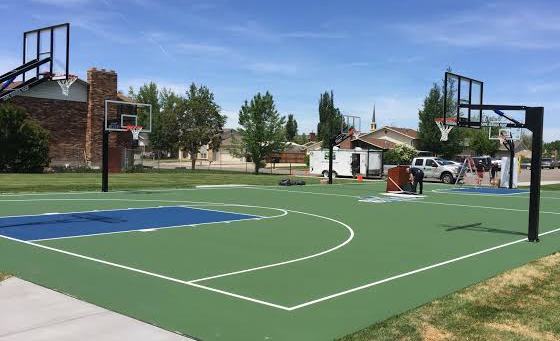
Every basketball courts project we take on includes the same foundation work: survey and subgrade testing, geotextile separation, compacted aggregate base, reinforced concrete and a surface system matched to your yard. Ask for a free written quote and you will see each of those as a line item.
What is included
- Free site visit, elevation shoot and subgrade probe
- Engineered base and drainage plan for your soil
- Reinforced, fiber-reinforced or post-tensioned slab
- Cushioned acrylic or modular polypropylene tile
- Laser-set striping, net posts, goals, fencing, LED lighting
- 8-year surface and workmanship warranty
Sizing a half court for a real backyard
A regulation high school half court is 42 by 50 feet. Most families are happy between 28 by 40 and 34 by 50, with the three-point arc scaled to the pad so shots still feel right. We stake the footprint in your yard with paint and string before pricing, so you can stand on the space and picture it.
Goals, footings and backboards
We set adjustable goals on 6-inch square steel posts in footings roughly four feet deep, always outside the playing surface. Tempered glass backboards give the best rebound; acrylic is lighter and cheaper. Breakaway rims are standard because teenagers are teenagers.
Slab, surface and ball response
Basketball punishes flat, hard surfaces. We pour a reinforced or fiber-reinforced slab, then finish with either textured acrylic for a fast surface or modular tile, which has lateral give that is easier on knees and ankles. Tile also handles Utah freeze and thaw with less maintenance.
Frequently asked questions about basketball courts in Utah
How does Utah County soil affect a basketball court slab?
A lot of the valley floor from Vineyard to Spanish Fork is lake-bed clay that swells when wet, while bench lots in Alpine and Highland hold rock and cobble. We test what is under your yard, over-excavate the soft spots and build a compacted aggregate base sized for that soil.
Can you pour a court pad during a Utah County winter?
We excavate and set base through much of the winter, but concrete needs protection once nights drop below freezing, and acrylic striping has to wait for warm, dry weather. Most Utah County winter projects get the base done early and the finish coats in spring.
How much does a backyard basketball court cost in Utah?
A half court usually lands between $25,000 and $60,000 in Utah County. The base and slab are the biggest line items. Modular tile, a glass backboard, fencing and lighting move the number up from there.
What is a good size for a home basketball court?
A regulation high school half court is 42 by 50 feet. Most families are happy between 28 by 40 and 34 by 50 feet, with the three-point arc scaled to the pad so shots still feel right.
How deep do basketball hoop footings need to be?
We set adjustable goals on 6-inch square steel posts in footings about four feet deep, placed just outside the playing surface. That depth keeps the pole steady through wind and hard dunks.
Is a concrete or tile basketball court better for knees?
Modular polypropylene tile flexes a little sideways, so it is easier on knees and ankles than bare concrete. Acrylic over concrete plays faster and truer. Both sit on the same reinforced slab underneath.
Will a basketball court crack in Utah winters?
Not if the base is right. We over-excavate, separate the soil with woven geotextile fabric, compact the aggregate in lifts, and reinforce the slab. Most cracked courts in Utah failed in the base, not the surface.
Can you extend my driveway into a hoop pad?
Yes, and it is one of the cheapest ways to get a real court. We tie a new reinforced pad into the driveway with a clean control joint, then stripe a key and set the goal off the playing surface.