Utah Sport Court Builder: How We Build a Sport Court That Stays Flat
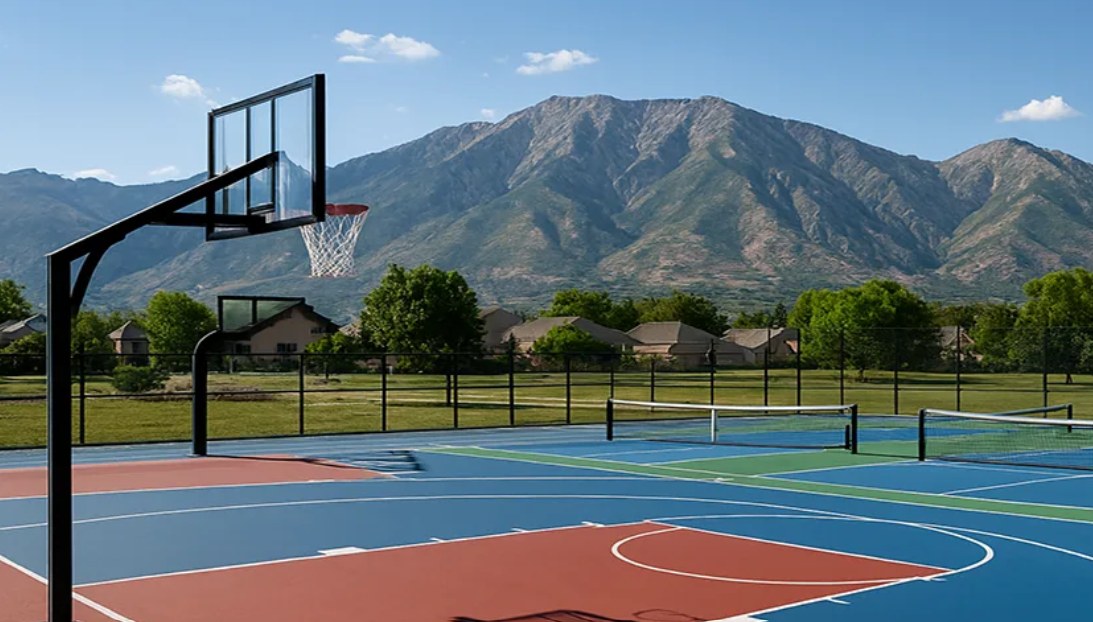
Utah Sport Court Builder builds pickleball, basketball and multi-sport courts across Utah County and Wasatch County using a base-first construction sequence: elevation survey, subgrade testing, geotextile separation, compacted aggregate base, reinforced or post-tensioned slab, then a cushioned acrylic or modular polypropylene surface system.
Most failed courts in Utah are base failures, not surface failures. The six stages below are the reason our courts still read flat and true years after the striping crew drives away.
The six-stage court construction sequence
Every residential and commercial court we build runs through the same stages, and each one shows up as a line item on your written quote.
1. Site & soil review
We shoot elevations, probe the subgrade, and identify clay, engineered fill or high groundwater before pricing anything.
2. Base & drainage
Over-excavation, woven geotextile separation, granular base placed in compacted lifts, perimeter drains where needed.
3. Slab
Reinforced, macro-fiber or post-tensioned concrete, screeded to a true one percent fall and cured under control.
4. Surface system
Cushioned acrylic or modular polypropylene tile, chosen for your sun, shade, drainage and play style.
5. Striping & equipment
Laser-set lines, net posts, adjustable goals, fencing, breathable windscreen and shielded LED lighting.
6. Walkthrough & warranty
Final punch list, care instructions and an 8-year surface and workmanship warranty in writing.
Materials and engineering specifications
- Compacted road base over woven geotextile fabric
- Welded wire mesh, macro-fiber or post-tension reinforcement
- 100% acrylic color systems with silica-sand texture
- Cushion layers for joint-friendly play
- Modular polypropylene tile with lateral forgiveness
- Black vinyl-coated chain link and 70 percent windscreen
- 5000K shielded LED fixtures on 18 to 20 foot poles
Timeline, permits and what happens on your street
A typical residential court takes three to four weeks of on-site work, weather permitting: one week for excavation and base, a slab pour with a controlled cure, then surfacing once moisture readings allow it. We pull permits, submit setback and lighting details, and schedule inspections so nothing stalls mid-build.
Curing and coating windows in Utah
Acrylic systems need surface temperatures above 50 degrees and a dry window, so late spring through early fall gives the cleanest results. Modular tile can go down in colder weather, which is why we often recommend it for winter installs.